As communities become denser, municipalities generate more tax revenue per acre. In fact, mixed-use development can increase tax revenue by up to ten times on average. The figure below illustrates property tax yield per acre by development type in Onondaga County. Mixed-use development produces significantly higher returns than other land uses and uses infrastructure more efficiently. Denser communities also spend less per unit to build and maintain linear infrastructure such as roads and sewers.
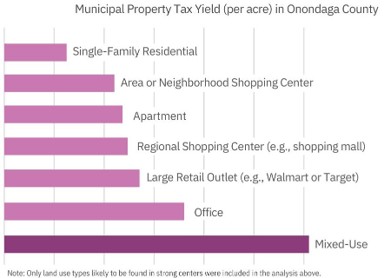
As communities become denser, municipalities generate more tax revenue per acre. In fact, mixed-use development can increase tax revenue by up to ten times on average. The figure below illustrates property tax yield per acre by development type in Onondaga County. Mixed-use development produces significantly higher returns than other land uses and uses infrastructure more efficiently. Denser communities also spend less per unit to build and maintain linear infrastructure such as roads and sewers.
Strong centers are essential to Onondaga County’s economic competitiveness. Companies increasingly select locations based on quality-of-life amenities that attract prospective employees. Skilled workers now prioritize mixed-use communities and often choose where to live before choosing where to work. As remote work expands, location flexibility increases. To compete for high-skilled jobs, Onondaga County must offer places that attract talent, support economic vitality, and function as vibrant centers for living and shopping.
Even in suburban communities, residents increasingly prefer denser, walkable environments that offer authentic local experiences rather than auto-oriented commercial centers dominated by chain stores. This shift away from traditional strip shopping centers has prompted municipalities to revisit site plan review processes and zoning to remove barriers to compact development.
Retail market changes are also reshaping suburban corridors. Large malls, including Great Northern Mall and ShoppingTown Mall in Onondaga County, have closed, leading communities to rethink land use and embrace mixed-use development supported by transit, and improved bicycle and pedestrian connectivity.
Transforming suburban strip districts requires more than zoning reform. Many lack the infrastructure needed for vibrant neighborhoods, including sidewalks, bicycle lanes, parks, and connected street networks.
Concentrating development in areas with existing water and sewer infrastructure reduces pressure on the County’s open space and agricultural lands. Between 1970 and 2020, the County’s urbanized area expanded significantly despite a relatively stable population.
The County anticipates major economic investment in the White Pine Business Park, bringing tens of thousands of new jobs. This growth creates an opportunity to strengthen existing and emerging centers, accommodate new development, and preserve valuable open space and agricultural resources.
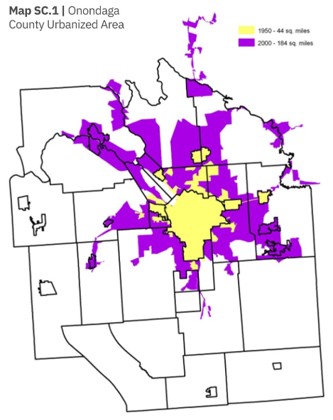
Concentrating development in areas with existing water and sewer infrastructure reduces pressure on the County’s open space and agricultural lands. Between 1970 and 2020, the County’s urbanized area expanded significantly despite a relatively stable population.
The County anticipates major economic investment in the White Pine Business Park, bringing tens of thousands of new jobs. This growth creates an opportunity to strengthen existing and emerging centers, accommodate new development, and preserve valuable open space and agricultural resources.
Strong Centers can help address housing affordability by supporting a broader range of housing choices, including single-family homes, two- and three-family units, townhomes, condominiums, and apartments. The density of mixed-use centers allows communities to offer diverse housing types that support aging in place and provide affordable options for residents across all income levels in the County.
Public transportation systems rely on sufficient densities in order to be able to provide efficient service. Increasing development in designated centers around transit service will help to strengthen the frequency, reliability, and attractiveness of transit as a mobility alternative.
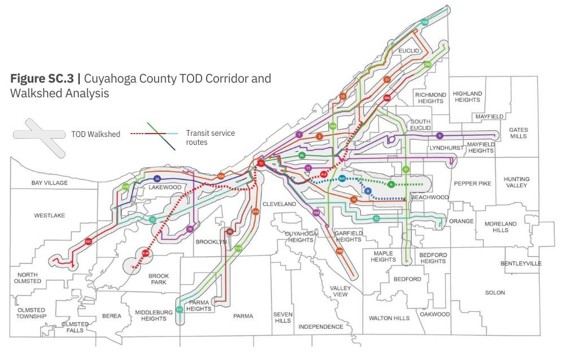
Transit-oriented development (TOD) means designing communities so that people, activities, buildings, and public spaces are within easy walking and cycling distances, and near-excellent transit service in order to access work, services, and play. TOD encourages pedestrian- oriented design with a dense mix of land uses including compact residential and commercial areas, smaller block sizes, design features that prioritize pedestrian safety, and local amenities such as parks, street trees, and public art. At the county scale, the implications of changing demographics and preferences on regional transportation investment priorities are profound. For example, more compact growth patterns will require significant shifts in the types of transportation improvements that will be needed in the coming years. Investments need to be coordinated between transportation departments, transit providers, planners, local planning boards, and developers. These groups can work together to understand and anticipate demographic and market shifts, identify strategic public transportation investments, and prioritize investments in local street networks and mobility infrastructure.
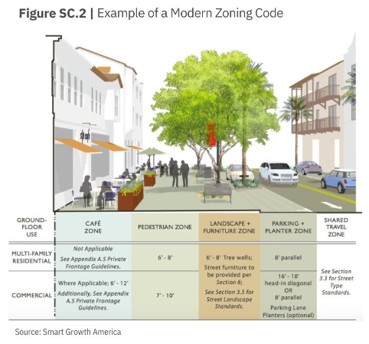
Strong Centers are places where multiple housing types can be integrated. Communities are working to address affordability by ensuring that local codes and ordinances support housing choice. Expanding the supply of “missing middle” housing, a term used to describe buildings that range in size and density from Accessory Dwelling Units (ADUs) to small- scale apartment buildings of ten to twenty units, has become an important component for solving the nation’s housing crisis. Small- scale housing such as ADUs and small multiunit buildings like duplexes and four-plexes are referred to as “missing” because they have largely been illegal to build in most neighborhoods throughout the U.S. due to local zoning restrictions.
After decades of sprawl and suburban growth, cities around the U.S., including Syracuse, have experienced an increase in population, growing employment, and new public and private sector investments in infrastructure, real estate, and placemaking. A great deal of this resurgence can be found in downtown areas, adjacent to waterfronts, and in special innovation districts where research institutions and entrepreneurs come together. Urban, suburban, and rural communities need to better understand these trends and harness the forces behind them in order to benefit. Successful places are implementing strategies that are broader than individual projects that include reinvigorating arts and creative districts, investing in university and medical districts, redesigning suburban office parks, and improving main streets. Typically investments include public outdoor performance spaces, parks, outdoor seating areas, public art, special lighting, and programming such as festivals. Collectively, these strategies help strengthen the broader regional economy to ensure that all citizens can participate in positive growth.
Strong Centers in Onondaga County:
Onondaga County has always had Strong Centers in its villages, hamlets, and city neighborhoods which began as pedestrian-oriented settlements built around main streets or commercial corridors. These places are connected to the history of the County, and are important County assets. Strengthening the traditional design of these communities, as well as adding new centers, can help to preserve the unique sense of place of the County. In addition, the quality of place is an increasingly important differentiator for the economic competitiveness of the County.
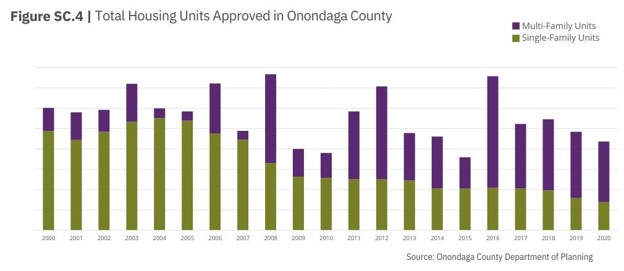
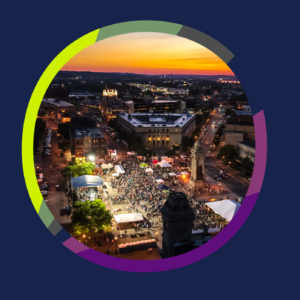
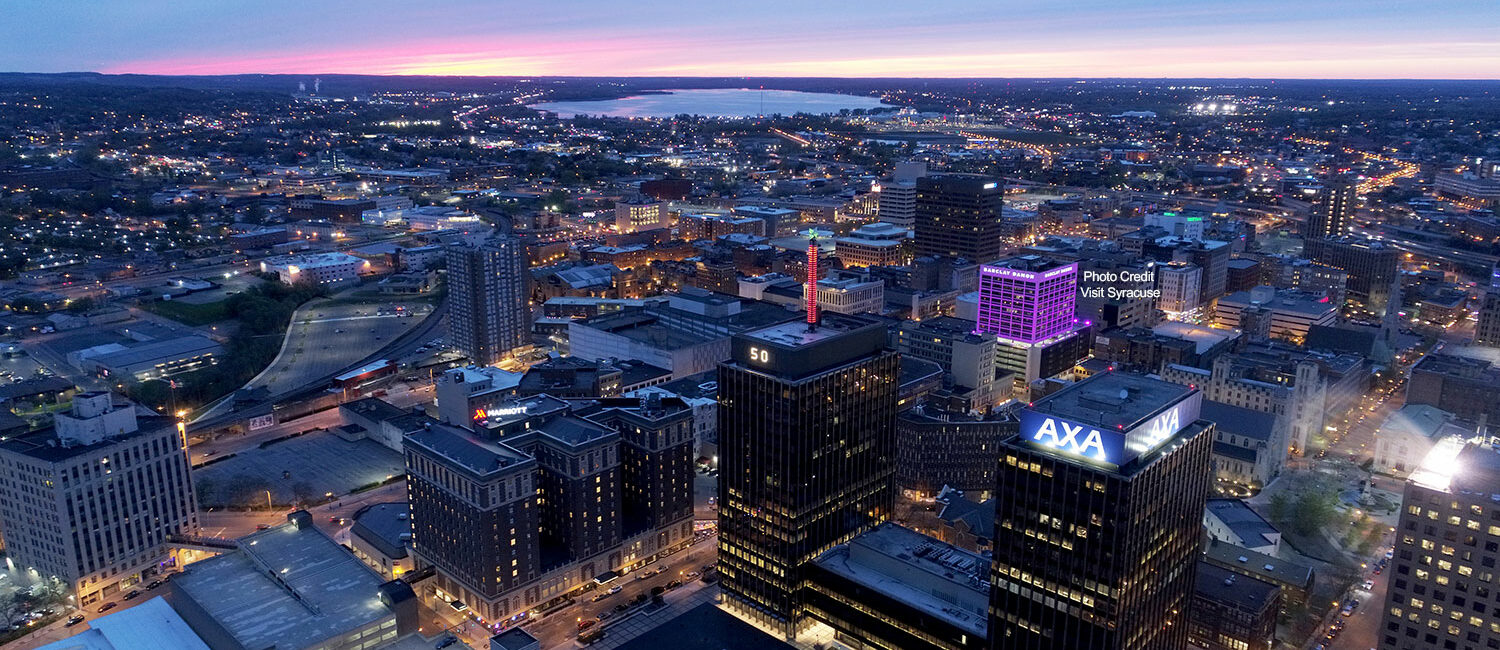
Downtown Syracuse and surrounding neighborhoods are the cultural center of Onondaga County. Over the last decade, over $800 million in capital improvements have been completed in Downtown Syracuse; and $265 million in additional projects are anticipated⁶. The growth that the city center has experienced mirrors demographic and development trends throughout the U.S. These investments have coincided with an increase in population and now over 4,3007 people live in the city center. A significant amount of that growth is related to the addition of housing units within Downtown and surrounding neighborhoods like Franklin Square, Park Avenue, and University Hill. Many of these multi-family projects are mixed-use (like the Salt City Market pictured to the right), meaning that they incorporate not only housing, but also commercial, retail, and community-based uses. Projects like the Salt City Market contribute population growth, liveliness, and economic strength to the city center, further enhancing available amenities, sense of place, and community. Changing demographics and lifestyle choices of Onondaga County residents are also evidenced by the trends in residential permits that have been issued in the County between 2000 and 2020. The number of permits for single-family homes declined, from a surge in the early 2000s, while permits for multi-family units have increased county-wide. Not all the growth in multi-family and mixed-use projects have occurred in the City of Syracuse. More permits for multi-family projects have been constructed in Onondaga County’s towns and villages (5,641) than in the City of Syracuse (4,146).
There has been a resurgence in many of the County’s urban and village centers. Significant investments in Baldwinsville, Liverpool, Camillus, Manlius, and Skaneateles, as examples, have helped to reshape and redefine village centers. Projects like the redevelopment of the Camillus Cutlery factory in the Village of Camillus demonstrate the importance of reuse of our historic village fabric. Rising demand for walkable “village urban” lifestyles is helping to fuel demand for the creation of mixed-use housing options in village settings. Outside of our villages, there are also examples of communities that have sought to reinvigorate suburban commercial districts by enabling mixed-use development. This type of development can be completed with good planning that directs land use policy and includes appropriate zoning of land. The structure of local zoning in communities in the County can facilitate and incentivize mixed-use development.
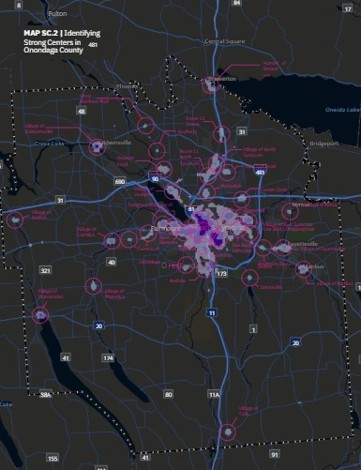
One thing that all strong centers share is a sense of vibrancy: the feeling of liveliness that comes from many different activities happening close to one another. Plan Onondaga utilized land use codes to identify contributors to vibrancy including retail stores, offices, shopping centers, mixed- use buildings, and grocery stores. Franklin Square, Downtown, and University Hill areas within Syracuse have the highest vibrancy scores. Areas such as Eastwood and the West Genesee Street Corridor scored a medium level of vibrancy, along with the village centers of Fayetteville, Manlius, East Syracuse, Liverpool, Baldwinsville, Marcellus and Camillus. While they exhibit a lower vibrancy level, smaller centers such as the hamlets of Brewerton and Jamesville, or smaller villages like Tully and Jordan, do indicate certain notable elements of vibrancy. Other commercial areas such as along Erie Boulevard in DeWitt, West Genesee Street in Fairmount, and Route 11 in Clay and the Town of Salina exhibit lower levels; but the incorporation of mixed-use land uses would dramatically increase the overall vibrancy. There are also locations which do not show in this vibrancy analysis, but still serve as important places in our communities such as the hamlets of LaFayette, Apulia, or Pompey. These hamlets act as a center for their communities, but are missing key land uses, a sufficient mix of land uses, or a concentration of land uses in the data and so they do not show up in this analysis; this does not diminish in any way their importance. With local input and analysis, vibrancy data can help the county and local communities to identify and prioritize where centers are, and where town centers could be. Once these centers have been identified, an assessment of market health, development barriers, and opportunities can be completed to identify needs and strategies for supporting future growth.